Pre Roman age

Flying over the landscape that surrounds Otricoli, between the hill and the waters of the Tiber, one can still sense the ancient dialogue between land and river, between the stability of the heights and the constant movement of one of central Italy’s most important waterways.
It was within this balance that the first settlements emerged during the 8th century BC. Archaeological evidence reveals a territory already organised around two complementary centres: the tuff plateau of La Scorga, a thriving river emporium connected to trade networks linking the Umbrians, Sabines, Faliscans and Etruscans, and the hill of Otricoli itself, home to a more protected and defensible settlement.
This dual system, river port and hilltop village, formed a closely integrated community. Its existence is documented through Iron Age pottery, contemporary necropolises such as Crepafico and Cerqua Cupa, and the remains of ancient structures scattered throughout the area.
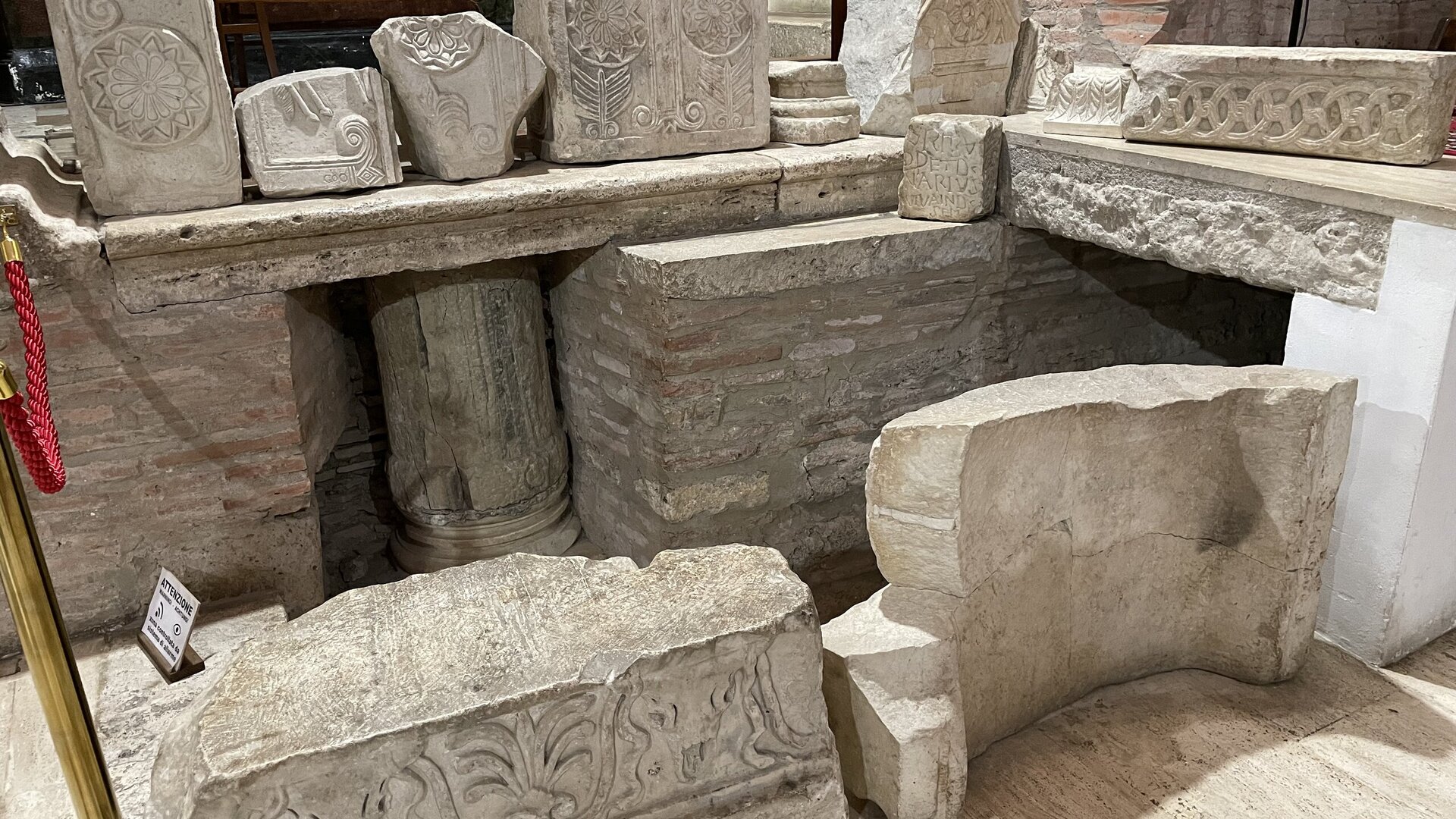
Excavations near the churches of San Vittore and Madonna del Buon Consiglio (formerly San Fulgenzio) have revealed traces of temple buildings, while beneath the present-day Collegiata archaeologists uncovered walls built in squared stone blocks, possibly belonging to an early sacred structure. Some scholars have even linked these remains to the cult of Valentia, a deity attested by local inscriptions and mentioned by the writer Tertullian as one of the few divinities worshipped exclusively outside Rome.
During the 4th century BC, the hilltop settlement was further strengthened by a defensive wall built from local tuff blocks, confirming its strategic and symbolic importance within the region. This fortified centre would later become the nucleus from which the Roman city of Ocriculum would emerge, transforming a flourishing pre-Roman landscape into one of the most significant urban centres along the future Via Flaminia.
From Okris to Ocriculum
The Latin name Ocriculum most likely derives from the Umbrian word okris, a term used to indicate a sacred height or elevated place of particular importance to the community. Over time, the word evolved through different linguistic forms ocar, ukar and the Latin concept of arx (fortified height or citadel), before taking the diminutive suffix -culum.
Its etymology reveals both a geographical and symbolic meaning: Ocriculum can be interpreted as “the little sacred height”, a place that likely served as a religious and civic reference point for the populations living along the Tiber Valley.